

Hey there! As a supplier of E Plane Bend Waveguides, I've often been asked about how these nifty devices work. So, I thought I'd take the time to break it down for you in a way that's easy to understand.
First off, let's talk a bit about waveguides in general. Waveguides are basically hollow metal tubes that are used to guide electromagnetic waves. They're commonly used in microwave and millimeter - wave applications, like in radar systems, satellite communications, and wireless networks. There are different types of waveguides, including rectangular, circular, and elliptical ones. And within that, we have specific components like the E Plane Bend Waveguide.
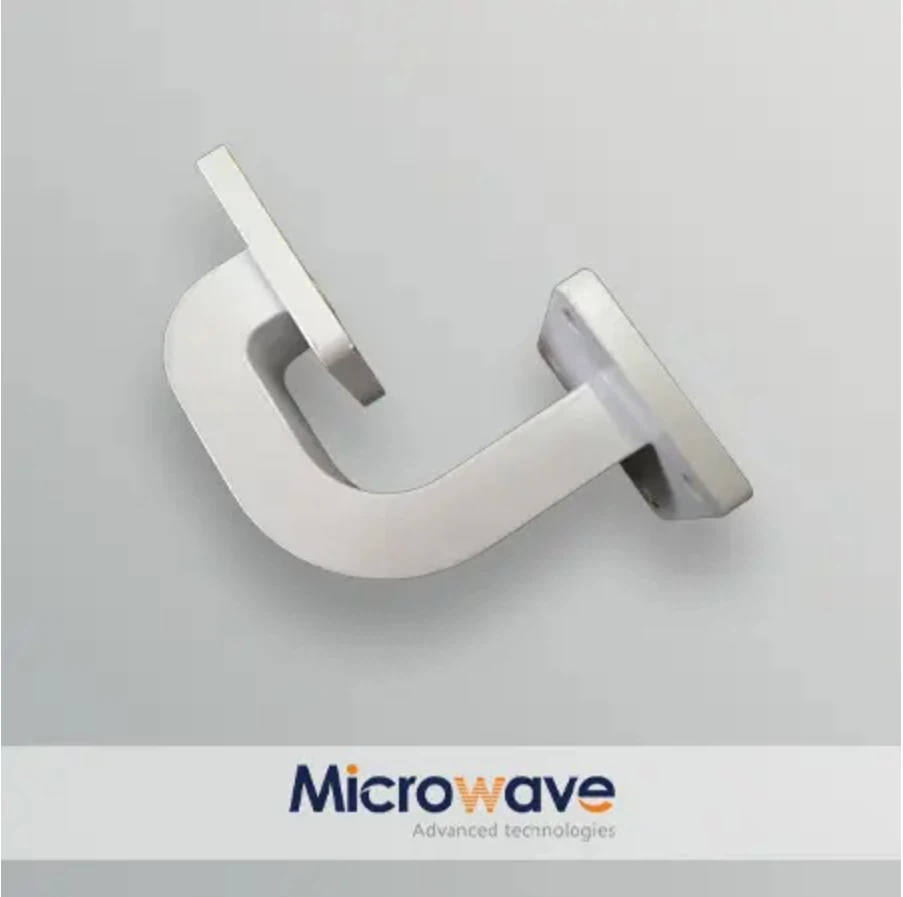

So, what exactly is an E Plane Bend Waveguide? Well, it's a type of waveguide component that's designed to change the direction of an electromagnetic wave in the E - plane. The E - plane is defined by the direction of the electric field vector of the electromagnetic wave. In a rectangular waveguide, the E - plane is the plane that contains the wider dimension of the waveguide cross - section.
Now, let's get into the nitty - gritty of how it works. When an electromagnetic wave travels through a waveguide, it propagates in a specific mode. The most common mode in rectangular waveguides is the TE₁₀ mode. In this mode, the electric field is perpendicular to the direction of propagation and has a single maximum across the wider dimension of the waveguide.
When the wave reaches the E Plane Bend Waveguide, the geometry of the bend comes into play. The bend is carefully designed to ensure that the wave is smoothly redirected without causing excessive reflections or losses. The key here is the curvature of the bend. If the bend is too sharp, it can cause the wave to reflect back, which is bad news as it can lead to signal degradation and interference.
The E Plane Bend Waveguide uses the principle of reflection and refraction of electromagnetic waves. As the wave hits the inner surface of the bend, it gets reflected in a way that changes its direction. The shape of the bend is engineered to match the phase and amplitude characteristics of the incoming wave so that the wave can continue to propagate in the new direction with minimal distortion.
One of the important factors in the design of an E Plane Bend Waveguide is the radius of curvature. A larger radius of curvature generally results in lower losses and better performance. However, it also takes up more space. So, there's always a trade - off between performance and physical size when designing these components.
Another aspect to consider is the frequency of the electromagnetic wave. Different frequencies have different wavelengths, and the E Plane Bend Waveguide needs to be designed to work effectively across a specific frequency range. This is known as the operating frequency band. For example, in some applications, we might need a waveguide that works in the X - band (8 - 12 GHz), while in others, it could be the Ka - band (26.5 - 40 GHz).
Now, let's talk about some of the applications of E Plane Bend Waveguides. They're widely used in microwave and millimeter - wave systems for routing signals around obstacles or changing the direction of the signal path. For instance, in a radar system, you might need to direct the microwave signal from the transmitter to the antenna in a specific direction. An E Plane Bend Waveguide can be used to achieve this without having to use a straight - through waveguide, which might not be practical due to space constraints.
If you're interested in other types of waveguide components, make sure to check out our H - Bend Waveguides and Twist Waveguides. These components are also used for changing the direction of electromagnetic waves, but they work in a different plane compared to the E Plane Bend Waveguide. And if you're looking for a component to couple signals in a waveguide system, our Waveguide Directional Cross Coupler is a great option.
At our company, we take pride in manufacturing high - quality E Plane Bend Waveguides. We use the latest manufacturing techniques and materials to ensure that our products meet the highest standards of performance and reliability. Our team of engineers is constantly working on improving the design and performance of our waveguides to meet the evolving needs of our customers.
If you're in the market for E Plane Bend Waveguides or any other waveguide components, don't hesitate to reach out to us. We're here to help you find the right solution for your specific application. Whether you need a standard off - the - shelf component or a custom - designed waveguide, we've got you covered. You can visit our E Plane Bend Waveguide page to learn more about our products and get in touch with us for a quote.
In conclusion, E Plane Bend Waveguides are essential components in microwave and millimeter - wave systems. They work by carefully redirecting electromagnetic waves in the E - plane, using the principles of reflection and refraction. With the right design and engineering, they can provide low - loss and high - performance signal routing solutions. So, if you have any questions or need more information, feel free to contact us. We're looking forward to working with you!
References
- Pozar, D. M. (2011). Microwave Engineering (4th ed.). Wiley.
- Collin, R. E. (1991). Foundations for Microwave Engineering (2nd ed.). McGraw - Hill.