

The Ka band, typically defined as the frequency range from 26.5 to 40 GHz, has become increasingly important in modern communication and radar systems due to its high data - transfer capacity and potential for high - resolution imaging. A Ka Band Circulator is a key component in these systems, and understanding how the magnetic field affects its operation is crucial for both its design and application. As a Ka Band Circulator supplier, I have witnessed firsthand the significance of this relationship.
Basics of a Ka Band Circulator
A circulator is a non - reciprocal three - or four - port device that allows the signal to flow in a specific direction, usually in a circular pattern. For a three - port Ka Band Circulator, a signal entering port 1 will exit from port 2, a signal entering port 2 will exit from port 3, and a signal entering port 3 will exit from port 1. This non - reciprocal behavior is what makes circulators so useful in microwave and millimeter - wave systems, as they can be used to separate transmit and receive signals in a radar or communication system.
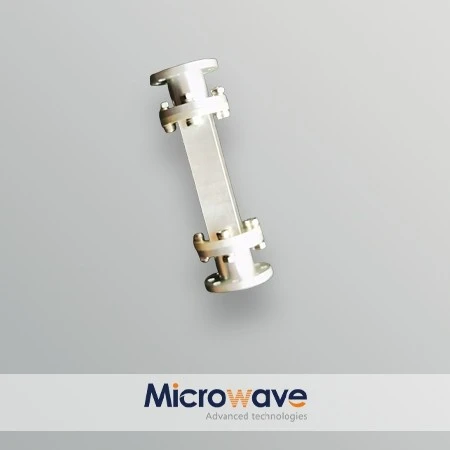

The operation of a Ka Band Circulator is based on the Faraday effect and the interaction between electromagnetic waves and a magnetic field in a ferrite material. Ferrite is a ceramic material with magnetic properties, and it is the core material used in the construction of circulators. When a DC magnetic field is applied to the ferrite, it changes the permeability of the ferrite for different polarization states of the electromagnetic wave, which leads to the non - reciprocal behavior of the circulator.
Influence of Magnetic Field Strength
The strength of the magnetic field applied to the ferrite in a Ka Band Circulator has a direct impact on its performance. A proper magnetic field strength is required to achieve the desired non - reciprocal behavior. If the magnetic field is too weak, the non - reciprocal effect will be insufficient, and the isolation between ports will be poor. Isolation is a key parameter of a circulator, which measures how well the circulator can prevent a signal from leaking back to the input port. For example, in a well - designed Ka Band Circulator, the isolation between ports should be at least 20 dB, and a weak magnetic field may reduce this value to less than 10 dB, which is unacceptable in most applications.
On the other hand, if the magnetic field is too strong, it can cause the ferrite to saturate. When the ferrite saturates, the permeability becomes constant, and the non - reciprocal effect is also affected. This can lead to an increase in insertion loss, which is the amount of signal power lost as the signal passes through the circulator. In a Ka Band Circulator, a high insertion loss can significantly degrade the performance of the overall system, especially in low - power applications. Therefore, it is essential to carefully select the magnetic field strength to ensure optimal performance.
Direction of the Magnetic Field
The direction of the magnetic field relative to the propagation direction of the electromagnetic wave in the ferrite is also critical. In a typical Ka Band Circulator, the magnetic field is applied in a direction perpendicular to the plane of the ferrite disk or slab. This configuration ensures that the electromagnetic wave experiences the maximum non - reciprocal effect. If the magnetic field is not applied correctly, the non - reciprocal behavior of the circulator will be disrupted.
For instance, if the magnetic field is applied at an angle to the ideal direction, the isolation and insertion loss characteristics of the circulator will be affected. The signal may not follow the desired circular path, and there may be cross - coupling between ports. This can cause interference in the system and reduce the overall reliability of the communication or radar system.
Temperature and Magnetic Field Interaction
Temperature can also have a significant impact on the relationship between the magnetic field and the operation of a Ka Band Circulator. The magnetic properties of ferrite materials are temperature - dependent. As the temperature changes, the magnetization of the ferrite and its permeability will also change. This means that the optimal magnetic field strength for the circulator may vary with temperature.
In a high - temperature environment, the magnetization of the ferrite may decrease, which requires a higher magnetic field strength to maintain the same non - reciprocal behavior. Conversely, in a low - temperature environment, the magnetization may increase, and a lower magnetic field strength may be sufficient. To compensate for these temperature effects, some Ka Band Circulators are designed with temperature - compensated magnets or additional control circuits to adjust the magnetic field strength according to the temperature.
Applications and Considerations in Systems
In radar systems, Ka Band Circulators are used to separate the transmit and receive signals. The magnetic field - related performance of the circulator is crucial for the overall performance of the radar. A high - isolation circulator can prevent the high - power transmit signal from leaking into the sensitive receive path, which can damage the receiver or cause false alarms. In communication systems, Ka Band Circulators are used in satellite communication and point - to - point microwave links. The low insertion loss and high isolation characteristics of the circulator are essential for ensuring high - quality signal transmission.
When selecting a Ka Band Circulator for a specific application, customers should consider the magnetic field requirements. They need to ensure that the magnetic field strength and direction can be properly maintained in the operating environment. Additionally, temperature compensation should be considered if the system will operate in a wide temperature range.
Related Products and Their Significance
As a Ka Band Circulator supplier, we also offer related products such as KU Band Waveguide Isolator and Ku Band 100w Isolator. These products are also based on the interaction between magnetic fields and ferrite materials. The KU Band Waveguide Isolator is used to protect the source from reflected signals, and the Ku Band 100w Isolator is designed for high - power applications. Understanding the magnetic field effects on these products is similar to that of the Ka Band Circulator, and our expertise in this area allows us to provide high - quality products.
Conclusion
In conclusion, the magnetic field has a profound impact on the operation of a Ka Band Circulator. The strength, direction, and temperature - related changes of the magnetic field all play crucial roles in determining the performance of the circulator. As a Ka Band Circulator supplier, we are committed to providing our customers with circulators that are carefully designed and tested to ensure optimal performance under different magnetic field conditions.
If you are interested in our Ka Band Circulators or other related products, we invite you to contact us for procurement and further technical discussions. Our team of experts is ready to assist you in selecting the right products for your specific applications.
References
- Pozar, D. M. (2011). Microwave Engineering. Wiley.
- Matthaei, G. L., Young, L., & Jones, E. M. T. (1964). Microwave Filters, Impedance - Matching Networks, and Coupling Structures. McGraw - Hill.
- Collin, R. E. (1992). Foundations for Microwave Engineering. Wiley.