

As a supplier of Ku Band 100w Isolators, I often encounter inquiries about the suitability of our products for military applications. In this blog post, I will delve into the technical aspects, performance requirements, and practical considerations to determine whether a Ku Band 100w Isolator can be effectively used in military scenarios.
Technical Overview of Ku Band 100w Isolators
The Ku band typically operates in the frequency range of 12 - 18 GHz. An isolator is a two - port device that allows the signal to pass in one direction with low loss while providing high isolation in the reverse direction. A 100w isolator is designed to handle continuous wave (CW) power up to 100 watts.
The basic principle of an isolator is based on the Faraday effect, which causes the polarization of an electromagnetic wave to rotate when it passes through a magnetized ferrite material. This rotation is non - reciprocal, meaning that the direction of rotation depends on the direction of the wave propagation. In a well - designed isolator, the forward - propagating signal experiences minimal loss, while the reverse - propagating signal is absorbed by a termination resistor, thus achieving isolation.
Military Application Requirements
Military applications have stringent requirements for electronic components, including isolators. These requirements can be classified into several key areas:

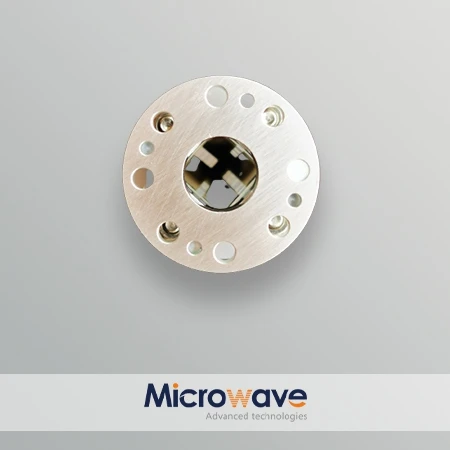
1. High Reliability
Military equipment often operates in harsh environments, such as extreme temperatures, high humidity, and high - altitude conditions. A Ku Band 100w Isolator used in military applications must be able to maintain its performance over a wide range of environmental conditions. For example, it should be able to operate reliably at temperatures ranging from - 40°C to 85°C without significant degradation in isolation or insertion loss.
2. Low Insertion Loss
Insertion loss is a critical parameter in military communication and radar systems. Low insertion loss ensures that the signal power is efficiently transmitted through the isolator, minimizing the power loss and maintaining the signal strength. In military applications, an insertion loss of less than 0.5 dB is often required for optimal system performance.
3. High Isolation
High isolation is essential to prevent signal reflections from interfering with the source or other components in the system. In military radar systems, for example, high isolation helps to reduce clutter and improve the accuracy of target detection. A Ku Band 100w Isolator used in military applications should typically provide isolation of at least 20 dB, and in some cases, even higher values may be required.
4. Compact Size and Lightweight
Military equipment often needs to be portable or installed in limited - space environments. Therefore, the isolator should be compact in size and lightweight. This allows for easy integration into military platforms such as aircraft, ships, and ground - based vehicles.
Compatibility with Military Systems
1. Communication Systems
In military communication systems, Ku Band 100w Isolators can be used to protect transmitters from reflected signals. For example, in satellite communication systems operating in the Ku band, the isolator can prevent the high - power transmitter from being damaged by reflections caused by impedance mismatches in the antenna or transmission line.
2. Radar Systems
Radar systems are another important application area for Ku Band 100w Isolators. In a radar transmitter, the isolator can isolate the high - power amplifier from the antenna, preventing the reflected signals from the antenna from affecting the performance of the amplifier. This helps to improve the stability and reliability of the radar system.
Comparison with Other Bands and Components
1. Comparison with Ka Band Isolators
Ka Band Isolator operate in the higher frequency range of 26.5 - 40 GHz. While Ka band isolators offer higher bandwidth and potentially better performance in some high - frequency applications, Ku Band 100w Isolators are more suitable for applications that require lower frequency operation and higher power handling. The choice between the two depends on the specific requirements of the military system.
2. Comparison with KU Band Waveguide Isolator 120W
Our KU Band Waveguide Isolator 120W has a higher power - handling capacity compared to the 100w isolator. If the military application requires higher power operation, the 120w isolator may be a better choice. However, the 100w isolator may be more suitable for applications where power requirements are lower, and cost or size is a more critical factor.
3. Comparison with Ka Band Circulators
Ka Band Circulator are multi - port devices that can be used to route signals in a specific direction. While circulators offer more flexibility in signal routing compared to isolators, isolators are simpler in design and are more suitable for applications where the main requirement is to prevent signal reflections.
Practical Considerations for Military Use
1. Certification and Compliance
Military applications often require components to meet specific military standards and certifications. As a supplier, we ensure that our Ku Band 100w Isolators are designed and manufactured in accordance with relevant military standards, such as MIL - STD - 810 for environmental testing and MIL - STD - 202 for electrical testing.
2. Customization
Military systems may have unique requirements that cannot be met by off - the - shelf components. We offer customization services for our Ku Band 100w Isolators, including modifications to the frequency range, power handling capacity, and physical dimensions, to meet the specific needs of military customers.
Conclusion
In conclusion, a Ku Band 100w Isolator can indeed be used in military applications. Its ability to handle 100 watts of power, combined with its performance in terms of low insertion loss, high isolation, and reliability, makes it suitable for a variety of military communication and radar systems. However, careful consideration must be given to the specific requirements of the military application, including environmental conditions, power requirements, and size constraints.
If you are interested in our Ku Band 100w Isolators for military applications or have any questions about our products, please feel free to contact us for procurement and further discussion. We are committed to providing high - quality products and excellent customer service to meet your military - grade needs.
References
- "Microwave Engineering", David M. Pozar, Wiley, 4th Edition.
- Military Standards and Specifications Handbook, Department of Defense.
- Technical Datasheets of Ku Band Isolators, Manufacturer's Documentation.