

In the realm of satellite communication and radio astronomy, the multiband feed system has emerged as a game - changer. As a dedicated multiband feed system supplier, I've witnessed firsthand the numerous advantages that these systems bring to the table. In this blog post, I'll delve into the key benefits of a multiband feed system, highlighting why it's a smart choice for various applications.
1. Cost - Efficiency
One of the most significant advantages of a multiband feed system is its cost - efficiency. Traditionally, when an organization needed to operate on multiple frequency bands, they had to install separate feed systems for each band. This not only involved a substantial upfront investment in hardware but also incurred additional costs for installation, maintenance, and space.
A multiband feed system, on the other hand, combines the functionality of multiple single - band feed systems into one unit. For example, a C/KU Multiband Feed System can operate on both the C - band and Ku - band frequencies. This means that users can save a significant amount of money on purchasing multiple feed systems. Moreover, the installation process is streamlined as there is only one unit to install, reducing labor costs. Maintenance is also simplified since there are fewer components to manage and service.
In a business context, cost - savings can have a direct impact on the bottom line. Companies can allocate the funds saved from using a multiband feed system to other areas of their operations, such as research and development or marketing. This makes the multiband feed system an attractive option for both large corporations and small - to - medium - sized enterprises looking to optimize their budgets.
2. Space Optimization
In many applications, especially in satellite communication ground stations and radio astronomy observatories, space is a precious commodity. Traditional single - band feed systems take up a considerable amount of space, especially when multiple systems are required to cover different frequency bands.
A multiband feed system offers a compact solution. By integrating multiple bands into a single unit, it significantly reduces the physical footprint. For instance, in a satellite ground station, where multiple antennas are often installed in a limited area, a Ka&Ku Multiband Feed System can be used instead of separate Ka - band and Ku - band feed systems. This allows for more efficient use of the available space, enabling the installation of additional equipment or antennas if needed.
In addition to ground - based applications, space optimization is also crucial for satellite systems. Satellites have limited payload capacity, and every cubic centimeter matters. Using a multiband feed system on a satellite can free up valuable space for other essential components, such as power supplies or communication transponders. This can lead to more efficient satellite design and potentially lower launch costs.
3. Enhanced Flexibility
Multiband feed systems provide users with a high degree of flexibility. They can be configured to operate on different frequency bands simultaneously or be switched between bands as required. This flexibility is particularly useful in dynamic communication environments where the frequency requirements may change over time.
For example, in a satellite communication network, the demand for different frequency bands may vary depending on the location, time of day, or type of service being provided. A multiband feed system allows operators to easily adapt to these changes. If there is a sudden increase in demand for Ku - band services in a particular region, the system can be quickly reconfigured to focus on the Ku - band without the need for extensive hardware changes.
In radio astronomy, the ability to switch between different frequency bands is also essential. Astronomers may need to observe celestial objects at different frequencies to gather more comprehensive data. A multiband feed system enables them to do this efficiently, without having to swap out feed systems.
4. Improved Performance
Multiband feed systems are designed to provide high - performance operation across multiple frequency bands. Advanced engineering techniques are used to ensure that the system can achieve low insertion loss, high gain, and excellent polarization performance in each band.
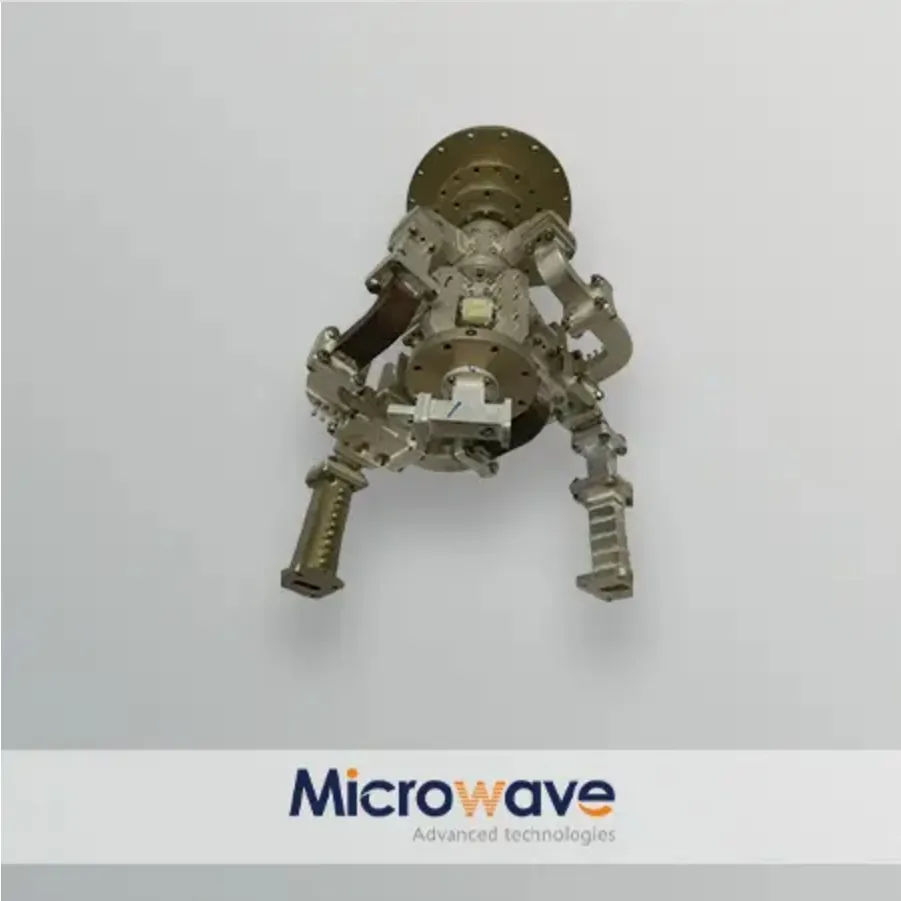

Low insertion loss is crucial as it minimizes the signal power loss between the antenna and the receiver or transmitter. This results in a stronger and clearer signal, which is essential for reliable communication and accurate data collection. High gain means that the system can amplify the received signals effectively, improving the signal - to - noise ratio. This is particularly important in applications where the received signals are weak, such as in deep - space communication or radio astronomy.
Polarization performance is also a key factor. Multiband feed systems can be designed to support different polarization modes, such as linear or circular polarization, depending on the requirements of the application. This allows for better signal reception and transmission, especially in environments where the polarization of the incoming signals may vary.
5. Simplified System Integration
Integrating multiple single - band feed systems into a larger communication or observation system can be a complex and challenging task. Each system may have different interfaces, power requirements, and control mechanisms, which need to be carefully coordinated.
A multiband feed system simplifies the integration process. Since it is a single unit, it has a unified interface and control mechanism. This makes it easier to connect the feed system to other components of the system, such as receivers, transmitters, and signal processors.
For example, in a satellite communication system, a C/KU Multiband Receive Only Feed System can be easily integrated with the existing ground station equipment. The system can be connected to the receiver using a standard interface, and the control software can be configured to manage the operation of the feed system across both the C - band and Ku - band frequencies. This simplifies the overall system architecture and reduces the potential for compatibility issues.
6. Future - Proofing
The field of satellite communication and radio astronomy is constantly evolving, with new frequency bands being explored and utilized. A multiband feed system provides a degree of future - proofing for users. As new frequency bands become available, many multiband feed systems can be upgraded or reconfigured to support these bands.
This is in contrast to single - band feed systems, which may become obsolete when new frequency bands are introduced. For example, as the demand for higher - frequency bands such as the Ka - band and V - band increases, a multiband feed system that is designed with upgradeability in mind can be modified to operate on these new bands. This allows users to adapt to technological advancements without having to replace their entire feed system.
Contact for Procurement
If you are interested in learning more about our multiband feed systems or would like to discuss a potential procurement, we encourage you to get in touch with us. Our team of experts is ready to provide you with detailed information, answer your questions, and assist you in finding the right multiband feed system for your specific needs. Whether you are in the satellite communication industry, radio astronomy, or any other field that requires high - performance feed systems, we have the solutions to meet your requirements.
References
- "Satellite Communication Systems: Design Principles" by Gerhard K. Holzman.
- "Radio Astronomy Handbook" by Thomas L. Wilson, Alison R. Rohlfs, and Susan H. Stoner.